Resource Guide • Primary-Source Series
QPP 2026, Explained From the Policy Itself
Rule 20, the 250km local workforce definition, and the three different 30% figures everyone confuses. Every claim on this page cites the Queensland Procurement Policy 2026 directly. Verified against the policy text, 10 July 2026.
What QPP 2026 is
The Queensland Procurement Policy 2026 is the government's overarching policy for the procurement of goods and services, commencing 1 January 2026, with the exception of the Procurement Assurance Model incentive scheme component, which commences 1 January 2027. QPP 2026
It is structured in five parts: the Queensland Procurement Approach, the Queensland Procurement Rules, the Procurement Assurance Model (PAM), a Glossary, and a Record of changes. The Rules replace the Queensland Procurement Policy 2023. QPP 2026, structure
The Approach is built on five foundational pillars aimed at maximising value for taxpayers' money, strengthening local businesses, simplifying procurement processes, encouraging innovation, and creating positive economic, environmental and social impact. The first, Value for Queensland, anchors the value-for-money framework. QPP 2026, Part 1
How the Rules work: must, should, may
Each rule carries one of three force levels. Must rules are mandatory for agencies. Should rules are not mandatory but represent best practice agencies are encouraged to apply. May rules give agencies flexibility. Reading a rule's verb tells you whether it binds. QPP 2026, Rules
The Rules also provide that for routine procurement, agencies invite at least one local supplier, small and family business, or Queensland regional business to respond where practical, documenting a reason where it is not. QPP 2026, Rules
Significant procurement and the $500,000 floor
Several of the strongest obligations attach only to significant procurement: procurement that is high value and/or high risk, with agency thresholds that cannot be set lower than $500,000 including GST. If a procurement sits below the agency's significant threshold, Rule 20's criterion is not required for it. QPP 2026, definitions
Rule 20: the purposeful public procurement criterion
This is the mechanism that replaced the Local Benefits Test, and the most misquoted part of the policy. The mechanics, from the rule itself:
Two practical consequences. First, there is no automatic location score: the criterion exists only on significant procurement, and local benefits only counts when selected. Second, the ceiling moved: the whole criterion tops out at 20%, and the local outcome alone at 10%. Anyone quoting a 30% location weighting is quoting the retired framework. The policy's own Record of changes shows Rule 20 was updated at publication (v1.1, 11 November 2025). QPP 2026, Record of changes
Who counts as local now: the 250km definition
The load-bearing definitions live in the Glossary, and the geometry surprised almost everyone:
Note what changed: the former test measured your workforce against the project site (125km). The current definition measures your workforce against your own premises (250km). Proximity to a project site is no longer part of the definition at all, though it remains commercially real for mobilisation cost and for regional-benefits responses, and agencies retain the discretionary radius outside SEQ.
The three different 30% figures
Most of the confusion in circulation comes from three unrelated numbers that all happen to be 30. Only two are current:
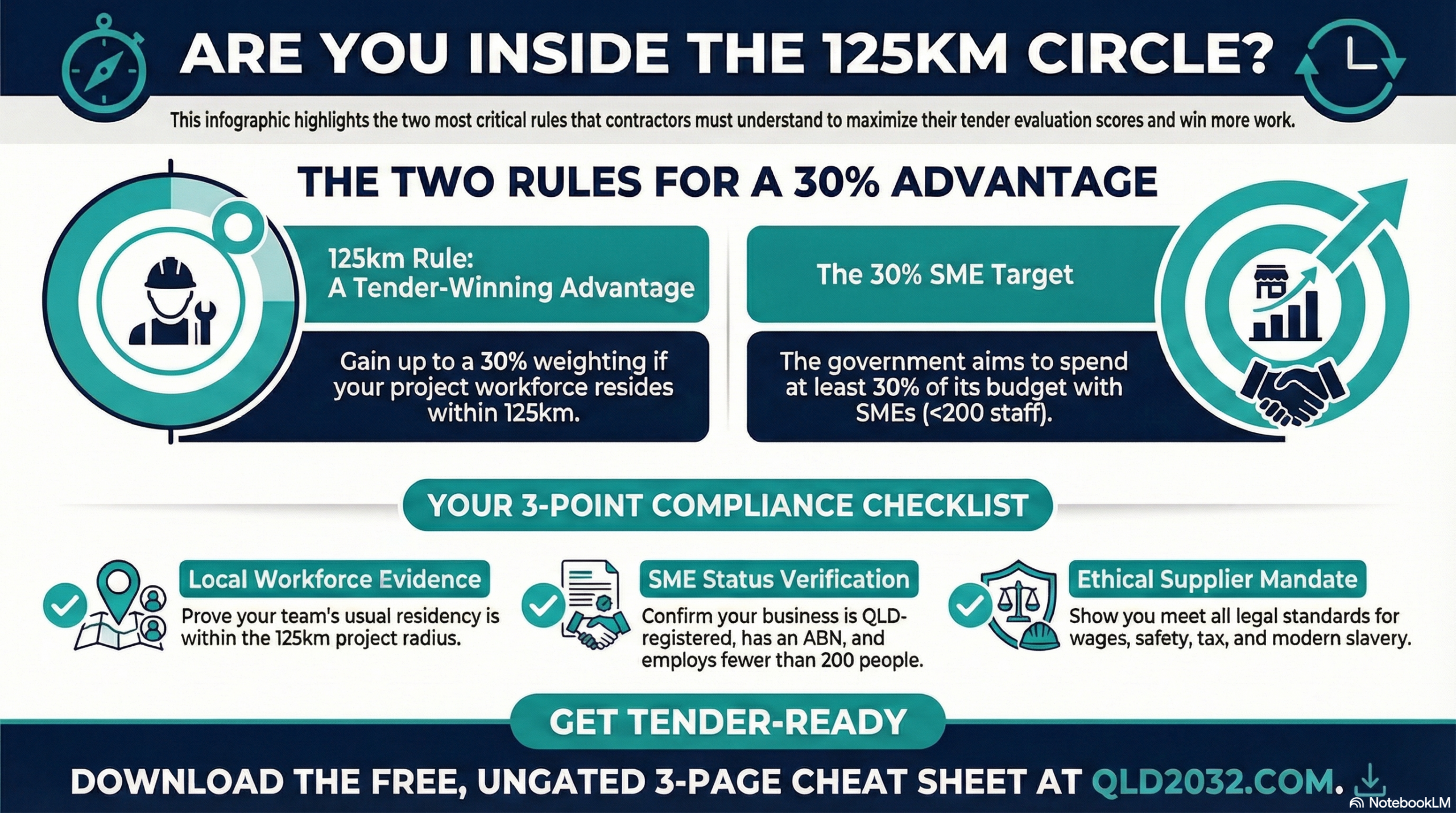
The former Local Benefits Test could carry an evaluation weighting of up to 30%. Retired 1 January 2026 with the framework that contained it. Old guidance PDFs quoting it remain online.
The government's target to source 30% of procurement by value from Queensland SMEs. A spend target measured across government, not an evaluation weighting on your tender.
QPP 2026 Rule 25 permits up-front contract payments of up to 30% for SMEs. A cash-flow provision, not a score.
Old rule vs new rules, side by side
| Former framework (to Dec 2025) | QPP 2026 (from 1 Jan 2026) | |
|---|---|---|
| Mechanism | Local Benefits Test | Purposeful public procurement criterion (Rule 20) |
| Geometry | Workforce within 125km of the project site | Workforce within 250km of the supplier's own premises |
| Weighting | Up to 30% | Criterion 10-20% total; each outcome 5-10% |
| Local's place | The test itself | One selectable outcome among 2-4 chosen per procurement |
| Applies to | Significant procurement under the former policy | Significant procurement; thresholds no lower than $500K inc GST |
Rule 20 Local Workforce Calculator
The definition is measurable, so measure it. Enter your premises postcode and your workforce's residential postcodes; the tool computes how many fall within 250km straight-line of your premises and writes the factual sentence a tender response can carry. It reports a measurement, not a verdict: whether and how local benefits scores on your tender is set by the tender documents.
What suppliers should actually do now
Know your own 250km number. The definition is about your premises, so the percentage is stable across tenders; compute it once, keep the evidence behind it. Read each tender's criterion. Which 2-4 outcomes the agency selected, and their weightings, are in the tender documents, not in the policy. Check the significant threshold. Below $500K (or the agency's higher threshold), Rule 20's criterion is not required. If you are an SME, know the other two 30%s. The spend target shapes agency behaviour in your favour, and Rule 25's up-front payment provision is worth raising in contract discussions. Watch PAM. The Procurement Assurance Model's incentive scheme component commences 1 January 2027 and will add a supplier-assurance layer on top of these rules. QPP 2026
The Games carve-out
One line in the policy matters disproportionately for the 2032 program this site covers: QPP 2026 states it does not apply to the extent of any direct conflict with obligations under the Brisbane 2032 Host Contract. Games-delivery procurement can therefore operate outside these rules where that conflict exists, which is worth remembering every time a venue package is benchmarked against standard procurement expectations. QPP 2026
Sources
Primary: Queensland Procurement Policy 2026 (policy page and PDF, Queensland Government), text verified 10 July 2026. Supporting official guidance: Supporting purposeful public procurement (Business Queensland). Historical, superseded: the former Local Benefits Test guidelines, retained here as the record of what changed. Our sitewide correction of the former framework was published 10 July 2026; the superseded guide remains at /125km-guide/.