ICN Visibility Playbook
The 'Ghost Profile' Trap: Are You Invisible on ICN Gateway?
How to get found by Tier 1 contractors and procurement managers in the $180B 2032 pipeline.
1. The $180 Billion Opportunity You Might Be Missing
As the Queensland Government gears up for an estimated $180 billion in procurement spend in the lead-up to 2032, the ICN Gateway has become a pivotal connection between major projects and local suppliers. Under QPP 2026, local benefits is a purposeful-procurement outcome (Rule 20: criterion weighted 10-20% of total on significant procurement), and ICN Gateway is one of the main places procurement managers look when they're trying to find capable local contractors.[1]
Yet thousands of qualified businesses fail to get noticed. The central problem is that many contractors treat their ICN profile as a one-time, "set and forget" registration. That single mistake can leave a business effectively invisible and missing out on work it is perfectly capable of delivering.[2]
2. Trap #1: The "Ghost Profile" Rule
The biggest factor determining your visibility is the type of profile you have. The difference between free and paid tiers is not just extra features; it directly affects whether buyers can find you at all in general searches.[3][4]
That means your ICN strategy has to match what you're trying to achieve:
In simple terms: using ICN like a job board (only ever applying to visible EOIs) is a different strategy from wanting to be shortlisted for work you never see advertised.
3. Trap #2: The 25-Word "Card View" Test
When a buyer searches for suppliers on ICN Gateway, the results page shows a short "card" for each business. ICN's guidance explains that only the first sentence of your summary appears in these results, which means you effectively have about 25 words to make an impact before the text is cut off.[5][4]
Most profiles waste that sentence on generic company history. A strong opening, by contrast, immediately tells a buyer what you do, where you do it, and whether you line up with their local benefits goals.
Trash vs Treasure
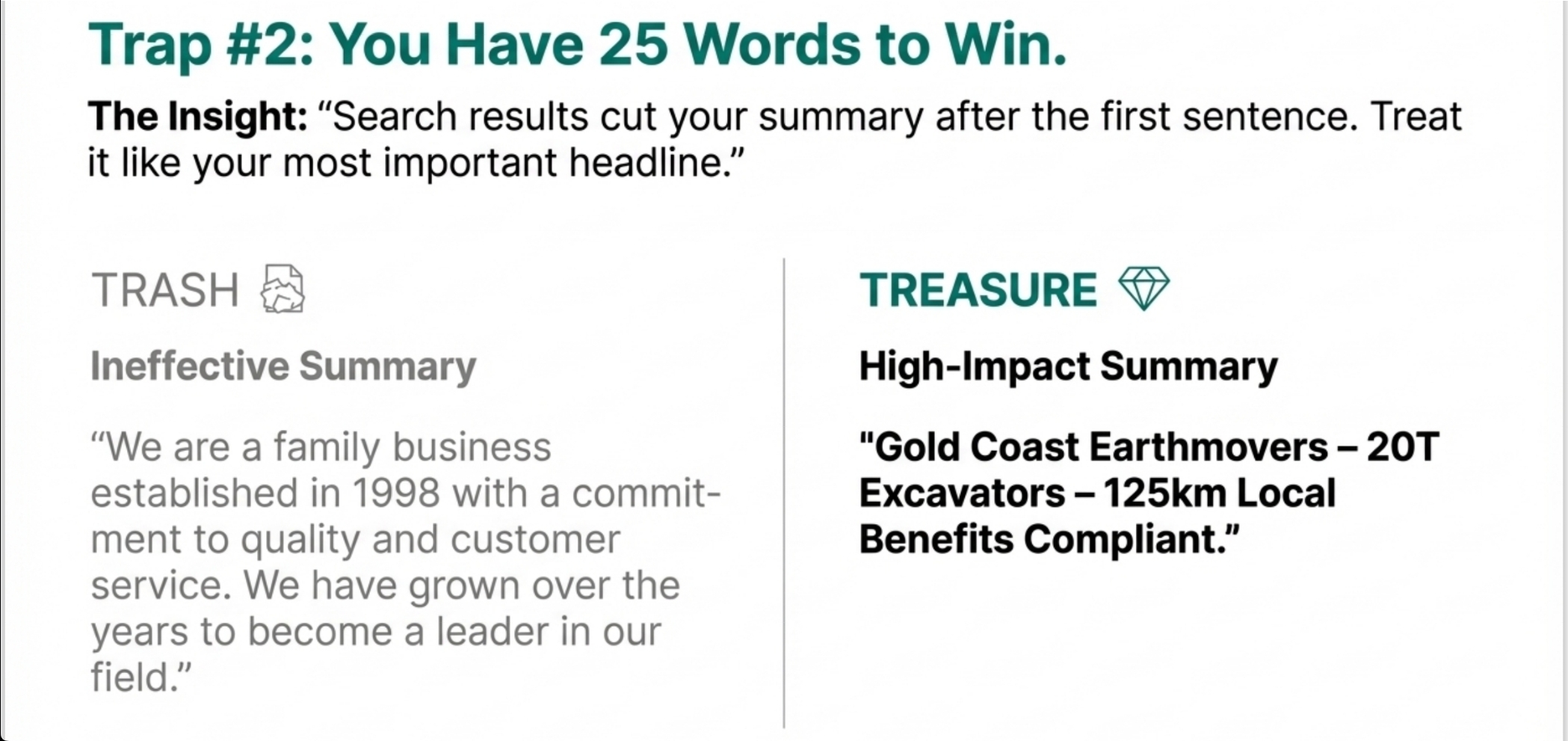
The "Treasure" version works because, in one line, it answers three buyer questions:
4. Trap #3: The "Green Tick" Verification Signal
The "Verified" badge on an ICN profile is a strong trust signal. ICN explains that buyers can filter by verified suppliers to quickly find businesses whose key details and documents have been checked, which helps them manage risk on major projects.[5][1][3]
That status isn't permanent. If core compliance documents expire or are missing, the verified status can be removed and, when buyers use filters that rely on up-to-date certifications, your business can be excluded from supplier shortlists before anyone reviews your capability statement.[6][5]
✅ Critical Maintenance Checklist
- Public Liability Insurance: current and uploaded
- WorkCover Insurance: current and uploaded
- ABN Details: correct and consistent with official records[3][5]
On top of that, uploading current trade licences and quality certifications such as ISO 9001 gives Tier 1 and government buyers extra confidence that you are set up for compliance-heavy work.
5. The Strategic Shift: Sell the Solution, Not the Machine
Buyers on ICN are rarely searching for a shopping list of equipment; they are looking for someone who can deliver specific outcomes on a work package. The more your profile reads like an equipment hire catalogue, the less it reflects how procurement teams actually think and search.[2][1]
A better approach is to rewrite your Products/Services section as capability statements:
Think like a procurement manager: what job would they type into the search box, and what compliance or local-benefit words would they expect to see in a strong profile? Those are the words that should appear in your capabilities.[1]
6. Your Action Plan: Download the ICN Visibility Playbook
Avoiding these traps is the first step. The next is to sit down with your actual ICN profile and apply the changes line by line.
To make that easier, the ICN Visibility Playbook pulls these ideas together into a practical toolkit. It includes:
- Printable "before and after" examples for summaries and capability statements
- A complete compliance checklist built from the ICN guides
- The 125km Local Benefits map
- Step-by-step profile optimisation framework