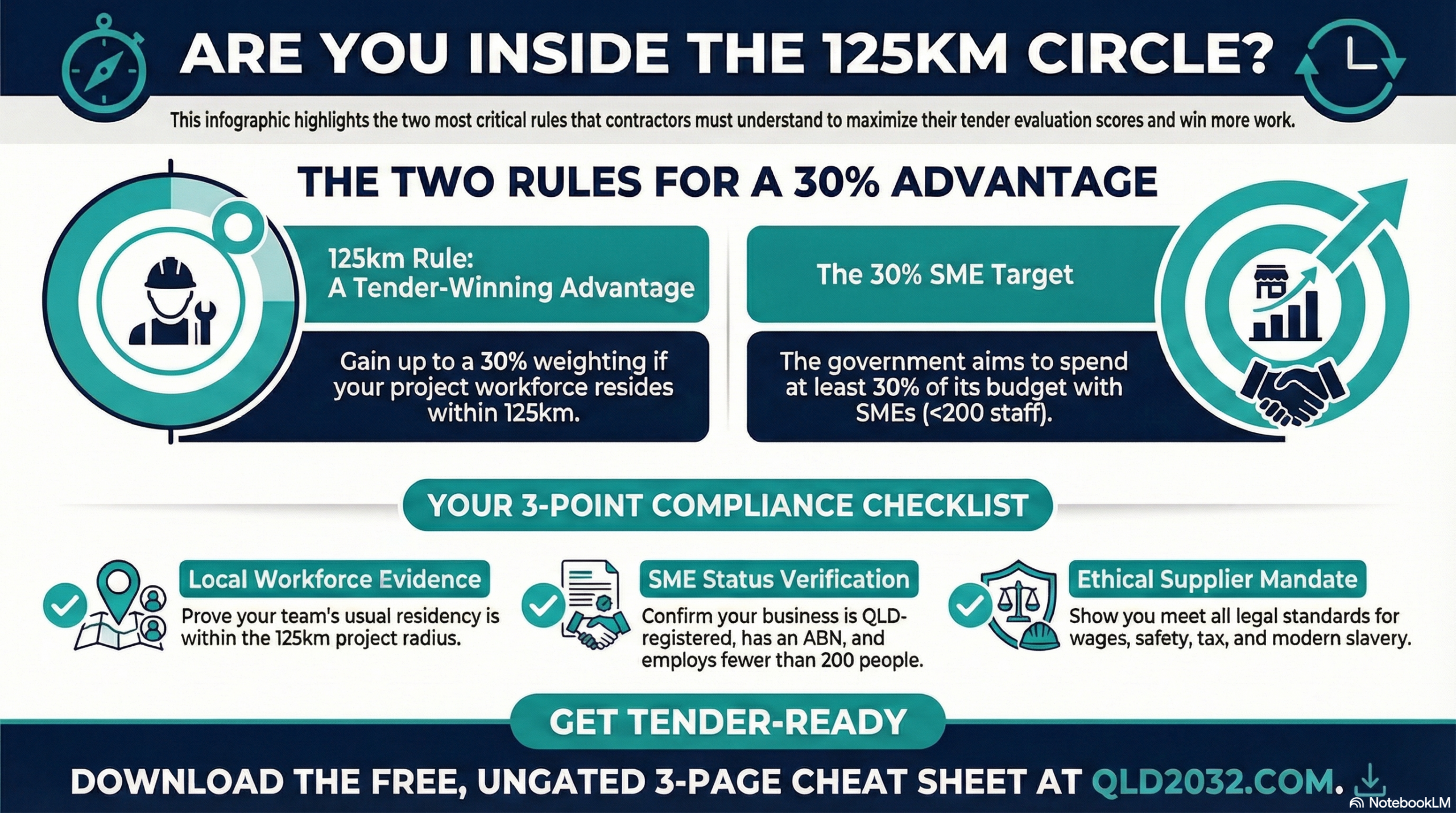
For a decade, one factor could carry up to 30% of a QLD tender score: where your workforce lived. QPP 2026 replaced that test in January. Here is what changed.
Update (10 July 2026): The framework this guide describes has been superseded. Under the Queensland Procurement Policy 2026 (commenced 1 January 2026), the Local Benefits Test has been replaced by a purposeful public procurement evaluation criterion carrying a maximum weighting of 10-20% (Rule 20), and "local workforce" is now defined as residing within 250km of the supplier's place of business, not 125km of the project site (QPP 2026 Glossary). The 30% figures below refer to the superseded framework; a separate 30% SME spend target still applies. The full replacement guide is now live: QPP 2026 explained, from the policy itself. Source: Queensland Procurement Policy 2026.
📍 125km Local Benefits Zone CheckerSuperseded Jan 2026: see update
Distance to Project
✔ Copied to clipboard. Ready to paste into tender.
✔ AI prompt copied. Paste into ChatGPT or your preferred AI tool.
Distance calculated using Haversine formula (straight-line). Actual road distance may vary. The 125km Local Benefits Test was replaced under QPP 2026 (Rule 20). This tool measures straight-line proximity only; see the update notice above.
The 30% Advantage You Can't Ignore
In Queensland Government tenders, a single factor could, until January 2026, carry an evaluation weighting of up to 30%. This isn't about price or experience — it's about your location.
As the state gears up for $180 billion in procurement spend leading up to 2032, the "Buy Queensland" policy gives local contractors a massive, score-based competitive edge.
Understanding how to leverage this advantage is no longer optional — it's critical to winning work.
What is the 125km Rule?
The 125km rule is a core component of the Queensland Government's official "Local Benefits Test." It defines exactly who qualifies for the maximum advantage.
Under the former test, a business was considered a "local supplier" if: Its workforce's usual place of residency is within 125km of where the goods or services are required.
This is not about your head office location — it's about where your workforce for a specific project actually lives.
The 125km radius from Brisbane includes major population and economic hubs such as the Sunshine Coast, Gold Coast, and Toowoomba. This puts thousands of Queensland businesses in the highest priority category.
Zone 1 Inside 125km (top preference)
Zone 2 Surrounding regional area
Zone 3 Rest of Queensland
Why This Is Your Key to Winning Tenders
For significant procurement conducted under the Buy Queensland approach, the Local Benefits Test carried a weighting of up to 30% of your total evaluation score.
Under the former test, 30% could outweigh lower prices from non-local competitors. Demonstrating you're "local" isn't a bonus — it's often the deciding factor.
Proving You're Local: The Compliance Challenge
To claim the former 30% weighting, suppliers had to be ready with evidence. Key requirements include:
📍 Local Workforce Evidence: Proof of employee residency + local hiring strategy
🏢 SME Status: QLD ABN, <200 employees, payroll/headcount verification
✅ Ethical Supplier Compliance: WHS, IR, tax, and modern slavery obligations
⚠️ Warning: Being unprepared can cause you to forfeit your biggest competitive advantage.
Your FREE 3-Page Cheat Sheet
To help Queensland contractors prepare, QLD2032.com has produced a clear, practical, 3-page guide that shows:
Exactly how the 125km rule works
What documents you must provide
How to structure your local benefits answers
The full checklist you must complete before tenders open